



Kidney Cancer Program Researchers Receive DOD Awards Totaling More Than $6M
UTSW kidney cancer drug shows promise against life-threatening hypercalcemia
Researchers at UT Southwestern, including James Brugarolas, M.D., Ph.D., Director of the Kidney Cancer Program, report that HIF-2α inhibitors—such as belzutifan, developed at UTSW—may effectively treat hypercalcemia, a dangerous calcium imbalance caused by kidney tumors.
Published in Cancer Discovery, the study shows that blocking HIF-2α reduces production of the hormone PTHrP, which drives elevated blood calcium. In preclinical models and a patient case study, treatment with HIF-2α inhibitors rapidly normalized calcium levels without the side effects of standard therapies.
“These findings support testing HIF-2α inhibitors as a targeted approach for kidney cancer patients with hypercalcemia,” said Dr. Brugarolas.
Read the full UTSW press release here.
RCC Animal Model Workshop Unites Global Experts in Kidney Cancer Research
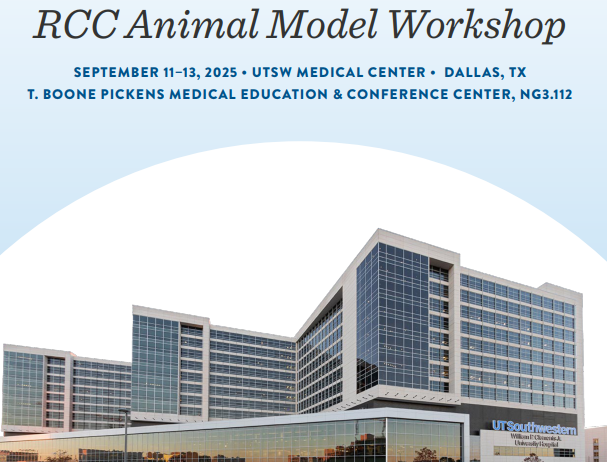
From September 11–13, 2025, the UT Southwestern Kidney Cancer Program, in partnership with the Kidney Cancer Association (KCA), hosted the first-ever RCC Animal Model Workshop at UTSW.
The three-day event brought together leading researchers from around the world to share findings, discuss challenges, and collaborate on the future of animal models in kidney cancer—highlighting UTSW’s leadership and long-standing contributions to this field.
Five distinguished keynote speakers headlined the workshop: Nobel Laureates Dr. William Kaelin (Dana-Farber Cancer Institute) and Dr. Bruce Beutler (UTSW); Dr. Andrea Ballabio (TIGEM, Italy), recipient of the 2025 Beth Levine, M.D. Prize in Autophagy Research; Dr. Richard Flavell (Yale University); and Dr. W. Marston Linehan (National Cancer Institute). View the online program here.
Sessions led by experts from Harvard, Johns Hopkins, MD Anderson, and other leading institutions covered topics ranging from genetically engineered mouse models to organoid and humanized systems. Presentations, panel discussions, and a hands-on PDX workshop underscored the event’s goal of standardizing and advancing kidney cancer models through collaboration and innovation.
“This was an inspiring gathering of leaders in the field,” said Dr. James Brugarolas, Director of the UT Southwestern Kidney Cancer Program. “By sharing knowledge and building standards together, we’re moving closer to new therapies for patients.”
To hear more of Dr. Brugarolas’ reflections, visit the Kidney Cancer Association’s Twitter here.
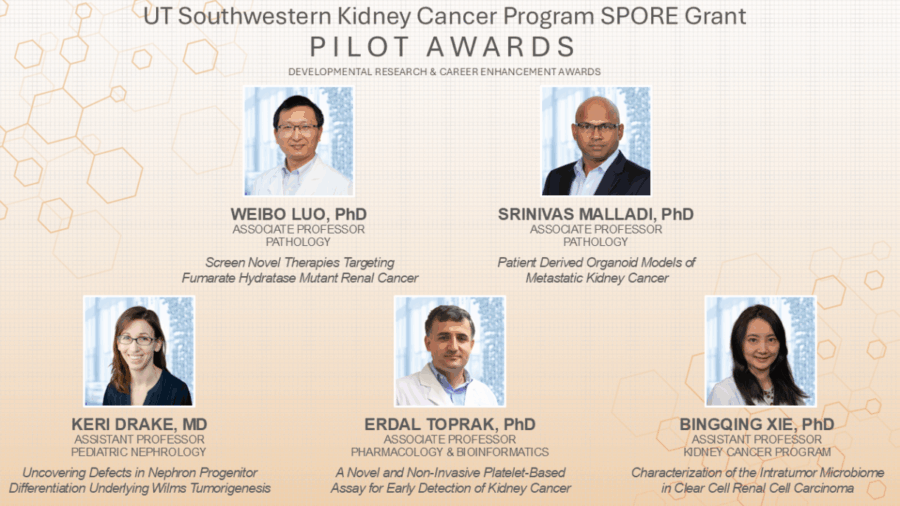
Researchers Granted Subawards from SPORE!
The KCP has awarded 5 more researchers with subawards from the SPORE grant to advance kidney cancer research. This competitive program is part of the larger Specialized Programs of Research Excellence (SPORE) grant and is designed to support innovative studies through two key initiatives: the Career Enhancement Program (CEP) and the Developmental Research Program (DRP). The CEP aims to bolster junior faculty and seasoned investigators transitioning into kidney cancer research, while the DRP funds high-risk, high-reward projects with significant translational potential.
Please join us in congratulating the following awardees and their groundbreaking projects:
- Dr. Weibo Luo – DRP
“Screen Novel Therapies Targeting Fumarate Hydratase Mutant Renal Cancer” - Dr. Srinivas Malladi – DRP
“Patient Derived Organoid Models of Metastatic Kidney Cancer” - Dr. Keri Drake – CEP
“Uncovering Defects in Nephron Progenitor Differentiation Underlying Wilms Tumorigenesis” - Dr. Erdal Toprak– CEP
“A Novel Non Invasive Platelet-Based Assay for Early Detection of Kidney Cancer” - Dr. Bingqing Xie – CEP
“Characterization of the Intratumor Microbiome in Clear Cell Renal Cell Carcinoma”
We are excited to see the impact of these research efforts and the advancements they will bring in improving patient outcomes.
UTSW develops AI-driven system to streamline research data collection
UT Southwestern researchers, including members of the Kidney Cancer Program, have developed a powerful new artificial intelligence (AI) system that can extract information from complex medical records with near-perfect accuracy.
Published in npj Digital Medicine, the study—co-led by Payal Kapur, M.D., Professor of Pathology and Urology and Kidney Cancer Program Co-Leader, and James Brugarolas, M.D., Ph.D., Director of the Kidney Cancer Program—demonstrates how AI can automate data extraction and standardization, dramatically reducing the time required to prepare research datasets.
The AI model achieved 99% accuracy in identifying tumor types and 97% in detecting metastasis across thousands of kidney cancer pathology reports. The approach, developed in collaboration with the Lyda Hill Department of Bioinformatics, could help accelerate large-scale clinical research in kidney cancer and beyond.
Study identifies new pathway tumors use to gain antioxidant protection
Researchers at Children’s Medical Center Research Institute at UT Southwestern (CRI) discovered that tumors can draw in lipoproteins—and the antioxidant vitamin E they carry—through a unique pathway involving sugar-coated cell structures called sulfated glycosaminoglycans (GAGs). This mechanism helps cancer cells resist oxidative stress and survive.
Published in Nature, the study was led by Javier Garcia-Bermudez, Ph.D., with collaboration from the Kidney Cancer Program. Using patient-derived kidney tumors, the team confirmed that clear cell renal cell carcinomas (ccRCC) contain elevated GAG and vitamin E levels, and that blocking GAG production made tumors less aggressive.
“These findings suggest antioxidants play an important role in kidney cancer survival and identify a potential target for new therapies,” said James Brugarolas, M.D., Ph.D., Director of the Kidney Cancer Program.
Study reveals how biomolecular condensates drive kidney cancer
UT Southwestern researchers have uncovered how certain genetic fusions trigger an aggressive form of kidney cancer through the formation of biomolecular condensates—protein networks that alter gene expression and promote malignancy.
Published in Cell, the study was co-led by Benjamin Sabari, Ph.D., with contributions from James Brugarolas, M.D., Ph.D., Director of the Kidney Cancer Program, whose team provided patient-derived samples for the research. The findings identify a shared molecular mechanism across diverse cancer-causing gene fusions and point to potential new therapeutic targets.
The discovery, made possible through samples maintained by the Kidney Cancer Program’s biorepository, could inform the development of treatments for translocation renal cell carcinoma and other cancers driven by similar mutations.
AI model predicts kidney cancer therapy response
A team led by UT Southwestern researchers, including Satwik Rajaram, Ph.D., Assistant Professor in the Lyda Hill Department of Bioinformatics and member of the Kidney Cancer Program, has developed an artificial intelligence (AI) model that can predict which kidney cancer patients are most likely to benefit from anti-angiogenic therapy.
Published in Nature Communications, the study shows that AI can analyze standard histopathological slides to identify patients likely to respond to treatment—offering a faster, more accessible, and interpretable alternative to existing genetic tests.
Dr. Rajaram co-led the research with Payal Kapur, M.D., Professor of Pathology and Urology and co-leader of the Kidney Cancer Program. The approach could eventually help guide treatment decisions for kidney cancer and beyond.
Dr. James Brugarolas Awarded ~1.2 Million from CPRIT Grant
The Cancer Prevention Research Institute of Texas (CPRIT) has awarded nearly $1.2 million to Dr. James Brugarolas, founding Director of the Kidney Cancer Program at UTSW. This funding will support his research into translocation renal cell carcinoma (tRCC), a rare and aggressive form of kidney cancer that primarily affects children and young adults.
tRCC remains poorly understood due to its rarity, and a lack of suitable models has hindered progress in developing effective treatments. The Brugarolas Lab recently developed a mouse model that replicates the human disease, providing a critical tool for further study. With this CPRIT grant, they will conduct mechanistic studies using the UTSW transgenic mouse core, led by Dr. Robert Hammer, and collaborate with Dr. Ben Sabari to explore potential drug therapies.
This research could lead to key insights into tRCC biology and lay the foundation for new treatment strategies, offering hope for patients with this challenging disease.
Read more about the award here.
Three UTSW Postdocs Receive Kidney Cancer Research Program Awards
- Dr. Jun Fang from Dr. Qing Zhang’s lab was recognized for her work on HIF-2α regulation in ccRCC. Her research focuses on Suppressor of Cytokine Signaling 3 (SOCS3) and its role in controlling HIF-2α through the JAK-STAT pathway. Her findings could lead to alternative treatment options for patients resistant to current HIF-2α inhibitors like Belzutifan.
- Dr. Arijit Mal from Dr. James Brugarolas’ lab received funding for his research on hypercalcemia in clear cell renal cell carcinoma (ccRCC). His project aims to uncover how HIF2α selectively regulates PTHrP.
- Dr. Tao “Dylan” Wang, also from Dr. Zhang’s lab, received this funding for his research using CRISPR screening to identify oncogenic enhancers in ccRCC. His work highlights a novel PLXNA1 gene enhancer that drives tumor growth, with potential therapeutic implications for targeting ccRCC at the epigenetic level.

UTSW Hosts VHL Family Weekend with Expert Insights from Dr. Brugarolas
UT Southwestern hosted the 2024 VHL Family Weekend on September 7, bringing together families, patients, and experts for a day of connection, learning, and collaboration.
Dr. James Brugarolas participated in a panel discussion alongside other VHL specialists to discuss Belzutifan, the recently FDA-approved drug for treating renal cell carcinoma in VHL patients. The event also featured interactive workshops, expert presentations, and opportunities to connect with the VHL community.
Beyond the sessions, attendees enjoyed family-friendly activities and the chance to explore Dallas. The weekend highlighted UTSW’s ongoing commitment to advancing VHL research and patient care.